
Happy Thursday, GoldBuzzers!
If you were anywhere near social media yesterday morning you probably saw the posts: $450 billion wiped out of gold and silver in 15 minutes. The number is real, but it tells you almost nothing.
Today's Real Talk works out what that number actually measures, then gets to the question that matters more: with the US government paying 5.35 percent to borrow, gold should be a lot lower than $4,100. It isn't, and this correction is going to tell us whether that's a new rule or a long pause in the old one.
Ok. Let’s get into it. ⬇️
The Scoreboard 🏆

Gold slipped more than one percent on Wednesday to finish at $4,110 an ounce, its lowest level in over a month, and silver fell more than two percent under $60, ground it hasn't covered since early August.
The pressure continues to come from the bond market. Long-term government borrowing costs in the US and other big economies have climbed to heights not seen in decades, and when bonds pay that well, holding metal that pays nothing carries a real short-term cost. A firmer dollar didn't help either.
Minutes from the Fed's September meeting - the one that delivered the first rate hike in more than three years - landed Wednesday afternoon, and traders are still weighing whether officials will follow through on the one further increase most of them penciled in for this year. Futures markets expect the Fed to sit tight at the end of October but put roughly two-in-three odds on a December hike.
While it’s uncomfortable to watch, none of this changes where we stand: both metals are still higher than they were a year ago, with silver up around 25 percent.
The GoldBuzz Top 10 is on sale now
Ten gold stocks, selected by the same system I use for my own money. Built to buy and hold, not trade. 38 pages, three on every stock, and your purchase earns a full credit toward annual INSIDER.
Real Talk 🎯

Gold's 20-year rule is being tested
Around 8am New York time on Wednesday, gold dropped from $4,120 to $4,066 in about 15 minutes and silver lost a dollar. Within the hour, X was full of posts announcing that $450 billion had been wiped out of the two metals.
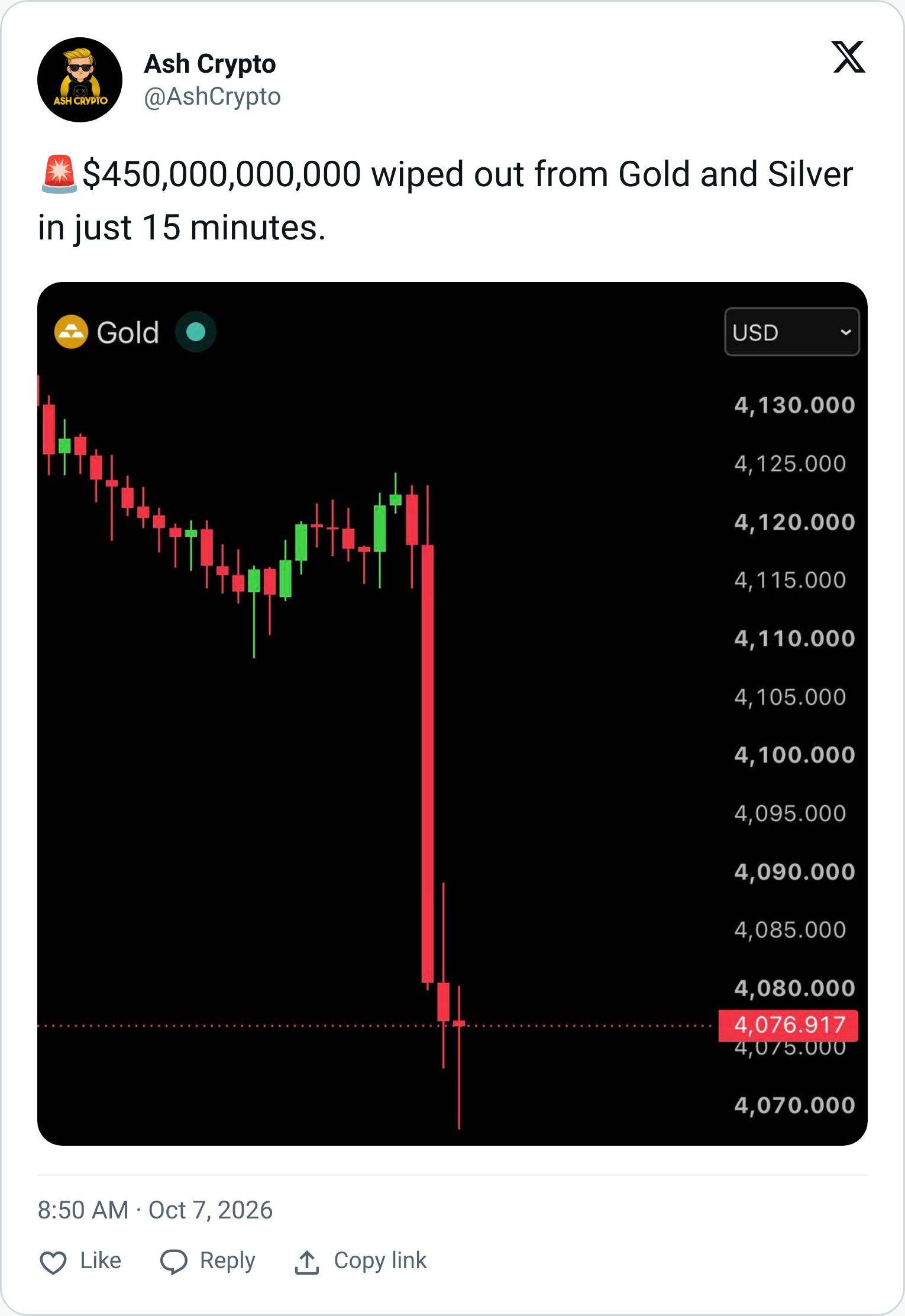
The number isn't invented. Multiply a $54 fall by every ounce of gold ever mined, about 216,000 tonnes by the World Gold Council's count, and you get $375 billion. Add silver and you're close to $440 billion. The catch is that the same sum works on any day, in either direction, and nobody quotes the figures on the up days.

Source: GoldBuzz price data, World Gold Council above-ground stock estimate. Daily close-to-close change multiplied by 216,000 tonnes. Data to 7 October 2026.
I ran the GoldBuzz database yesterday against every trading session this year. Gold's paper value has moved by more than $400 billion on 76 of the 192 days so far in 2026, 37 of them up and 39 down. Wednesday's move only ranks 79th by size. The biggest, of course, was 30 January, when the arithmetic says $3.4 trillion vanished in a single session.
None of it goes anywhere. The metal is still in the vaults, repriced for a few minutes on thin trading before the US open, and gold closed back above $4,100. Tuesday's feature covered who was doing that selling, so I won't repeat it. The more useful question is why gold is anywhere near $4,100 at all, given what bonds are paying.
A rule that worked for 20 years
For most of the past two decades, if you wanted to know where gold was heading, you looked at one number: the real yield on a ten-year Treasury. That's the interest the US government pays on a ten-year loan, minus expected inflation, so it's what you actually earn for lending to Washington for a decade.
Gold pays nothing. So when real yields rise, holding gold costs you more in income you've given up, and the price should fall. When real yields drop, especially below zero, gold has nothing to beat, and the price should rise.
It worked beautifully. From 2009 to 2021 the two moved in opposite directions almost without exception, with a correlation of minus 0.9, which in markets is about as close to a law as you get. Real yields went below zero for the first time in August 2011, and gold made a record near $1,900 within two weeks. They jumped in 2013 and gold fell 28 percent that year. Even in the quiet stretch from 2014 to 2019, when neither went anywhere, gold still fell on the weeks real yields rose and rose on the weeks they fell.

Source: GoldBuzz price data, Federal Reserve Bank of St. Louis (10-year TIPS yield). Weekly data, 2003 to October 2026.
Where it bent
For 13 years the two lines on that chart head in opposite directions. Then came 2022. The Fed raised rates faster than at any time since the early 1980s, and real yields went from minus one percent to plus 1.7 percent inside ten months. By the old rule gold should have lost a third of its value. It dipped to $1,620 and then went back up.
Since the start of 2022, the correlation has flipped to plus 0.48. Gold and real yields have been rising together. Real yields peaked at 2.5 percent in October 2023 and gold still finished that year at a record. This week the real yield reached 2.95 percent, higher than at any point since a few weeks in the 2008 crisis, and gold is at $4,100, up more than 50 percent on two years ago.
The rule still works on any given day. Wednesday was the rule working: yields up, gold down. What's changed is where the price settles afterwards.
Why the rule stopped working
The rule assumed a yield carries one message: how much you'll earn. It carries a second one, and the market has started paying attention to that instead.
A ten-year yield of 5.35 percent, where it stood on Monday and the highest since 2002, means the US government now pays 5.35 percent to borrow for a decade, on a debt that grows every year. The higher yields climb, the more of the budget goes on interest, and the more new Treasuries have to be sold to cover it.
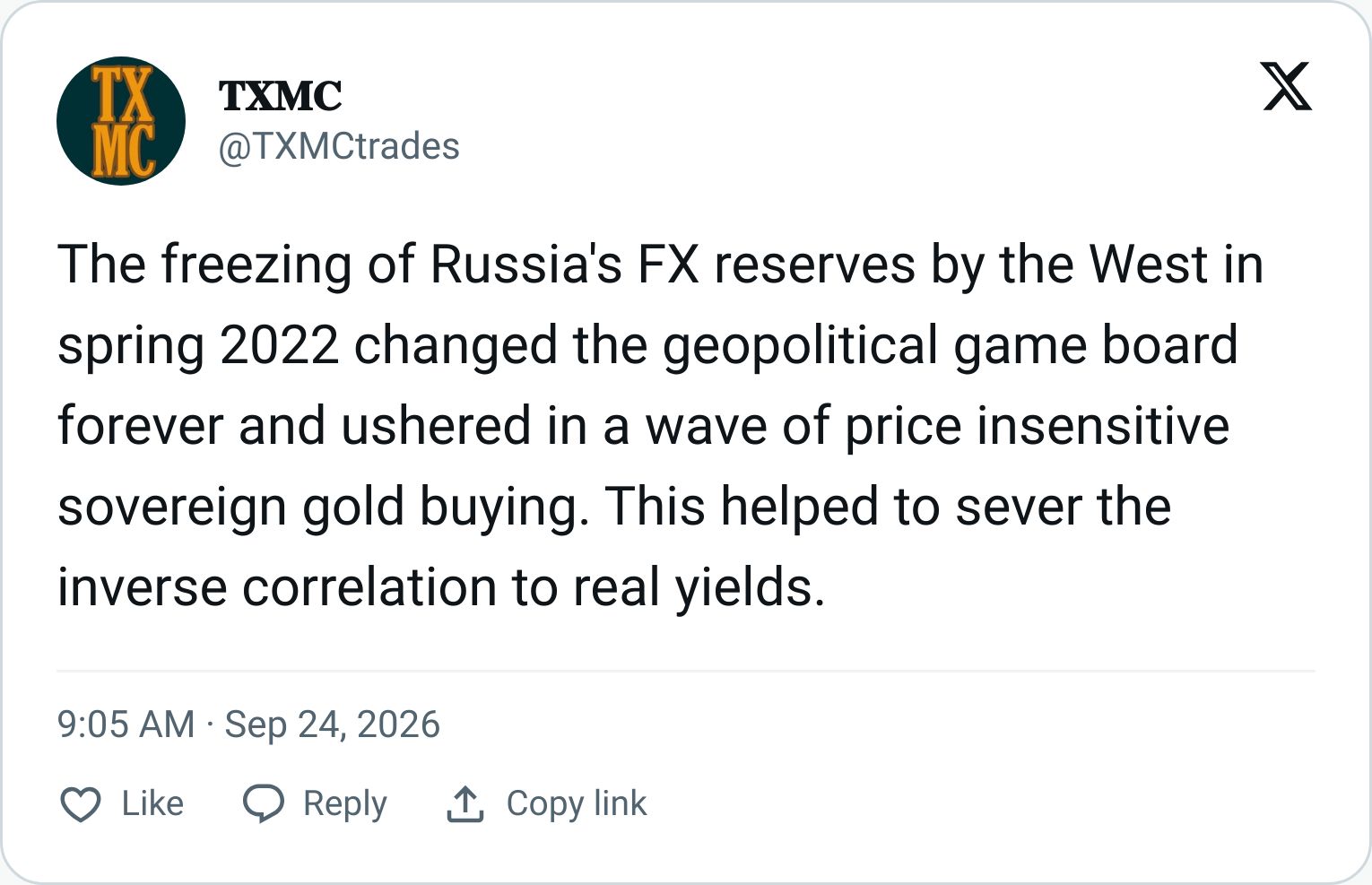
If that's what worries you, a higher yield makes gold more attractive, not less, because gold is the one thing no government can issue more of. That's why ETF holdings reached a four-year high in September while the gold price fell more than six percent, and why Wednesday's 15-minute drop found buyers within the hour.
Two readings of this week
The bear case is that the old rule comes back. The Fed raised rates again in September and markets expect more. The dollar is at its strongest since April 2025. If the people buying on debt worries pause for a quarter, there isn't much holding gold above $4,100, and Saxo Bank's Ole Hansen, who has written about this divergence for weeks, thinks the near-term path is lower.
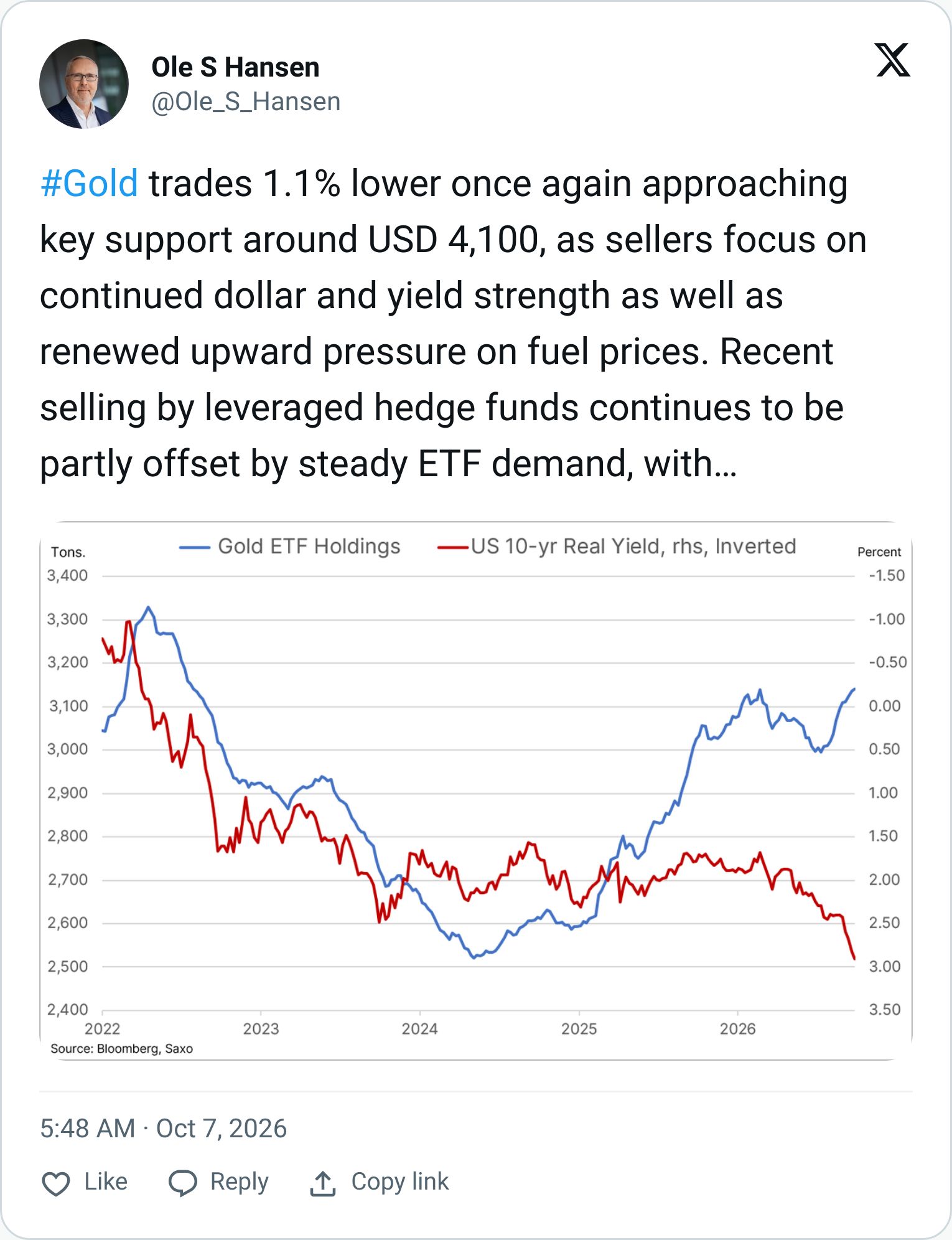
The bull case is that $4,100 held on Wednesday and the drop cleared out traders who'd borrowed to bet on gold. The buyers who care about the deficit rather than the interest haven't gone anywhere.
Which of those plays out over the next month, we’ll soon find out. A rule that held for more than a decade stopped working in 2022 and hasn't started again, though, and the thing that bent it, governments borrowing at rates they can't comfortably afford, is getting much worse. If this correction runs further, we'll find out whether the rule was broken or only suspended. Either way, this is the consolidation phase of a bull market that will ultimately take gold past $10,000.
📦 Recommended Resources
Here are some of the companies I personally use and recommend:
Allocated Storage - BullionVault
🇺🇸 Gold IRA - My quick guide to Gold and Silver IRAs
🇨🇦 🇺🇸 Physical Delivery - Silver Gold Bull, Sprott Money
🔒 Where the signals stand
Today's feature leaves an honest gap: nobody knows yet whether the old rule is broken or only suspended, and you won't find out until the correction has either run its course or hasn't.
The INSIDER signals don't need to know. They don't run on real yields, the dollar or the news of the day. Each signal comes from a rules-based system I spent four years building from the original Theseus research, tested on over 50 years of gold and silver data, and it says one thing at a time: bullish or bearish for each market.
It flips when the trend changes, whatever the reason the trend changed. When it does, you'll see it on the members' page before the market opens.
It's what I use every day to manage my own investments.
The next signal change will be there first. I invite you to come and join us.
14-day money-back guarantee. Cancel anytime.
That’s all for this Thursday, folks. I’ll see you on Sunday.
Before you go, please take a moment to rate today’s newsletter and tell us how we did.
What did you think of today's GoldBuzz?
GoldBuzz INSIDER The System I Use for My Own Investing
The Gold Awakening Download Your Free Copy Here
Enjoyed today's issue? Forward it to a friend who needs more gold in their life. They can subscribe at goldbuzz.com
Got feedback? Hit reply and let me know what you loved (or didn't).
Rick Adams
Founder, GoldBuzz
rick@goldbuzz.com
