
Happy Tuesday, GoldBuzzers!
Since the midterms, gold, silver and especially the miners have pulled well clear of stocks and Bitcoin, and they did it straight through a jobs report that should have knocked them back.
In today’s Take Action Tuesday, I’ll be looking at what’s driving the move, a new milestone for the miners, and what this morning’s inflation number could change.
Ok. Let’s get into it. ⬇️
The Scoreboard 🏆

Gold closed Monday near $4,136, up almost two percent, and silver did even better, gaining nearly three percent to finish above $53. The push came from the oil market, of all places. Brent crude dropped almost six percent after President Trump said fresh strikes on Iran are highly unlikely while negotiations continue, capping oil’s steepest weekly fall since 2020. Cheaper oil means less pressure on inflation, and that takes some heat off the Federal Reserve.
It matters because markets now put the odds of a December rate hike at just over 80 percent, up from about 70 percent before Friday’s unexpectedly strong jobs report. Higher rates make interest-paying assets look better next to metals that pay nothing, so that’s the tug-of-war at the moment.
The next pull comes this morning: October’s US inflation report lands a couple of hours after this email reaches you. A soft reading would trim those hike odds and give metals more room to run, while a hot one would hand the advantage straight back to the Fed.
Take Action Tuesday 📅

Has the Rotation Started?
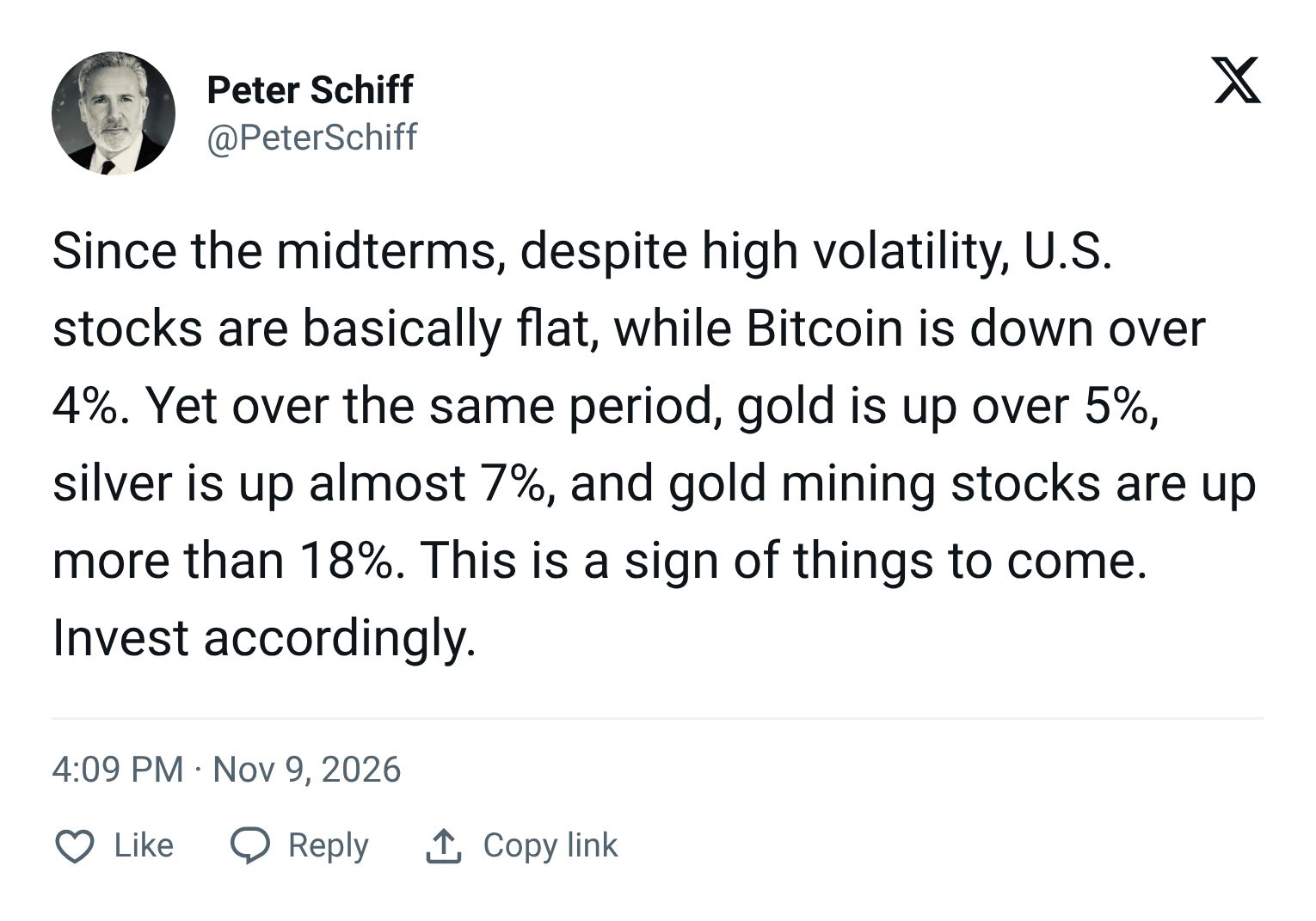
Since the midterm results came in, gold is up more than five percent and silver more than seven percent. Gold- and silver-mining stocks have done far better, with the four main mining funds up between 17 and 19 percent. Over the same stretch the S&P 500 has gone nowhere. Bitcoin has slipped about three percent, after being down nearly five percent at Monday’s low, and finished the day below $75,000, a level many crypto traders had treated as a floor.

Daily closes, 3-9 Nov 2026. GDX, GDXJ, SIL and SILJ are mining ETFs.
A gap that wide is starting to catch the eye of investors who don’t normally pay the metals much attention. Peter Schiff spotted it on Monday.
Shrugging off Friday’s jobs shock
The timing makes the move more impressive. Friday’s October jobs report showed 165,000 new jobs, about two and a half times what economists expected. A strong economy gives the Federal Reserve more reason to raise interest rates, and futures markets now put the odds of a December hike close to 80 percent. Higher rates usually hurt gold because it pays no interest, and both metals dipped on the news.
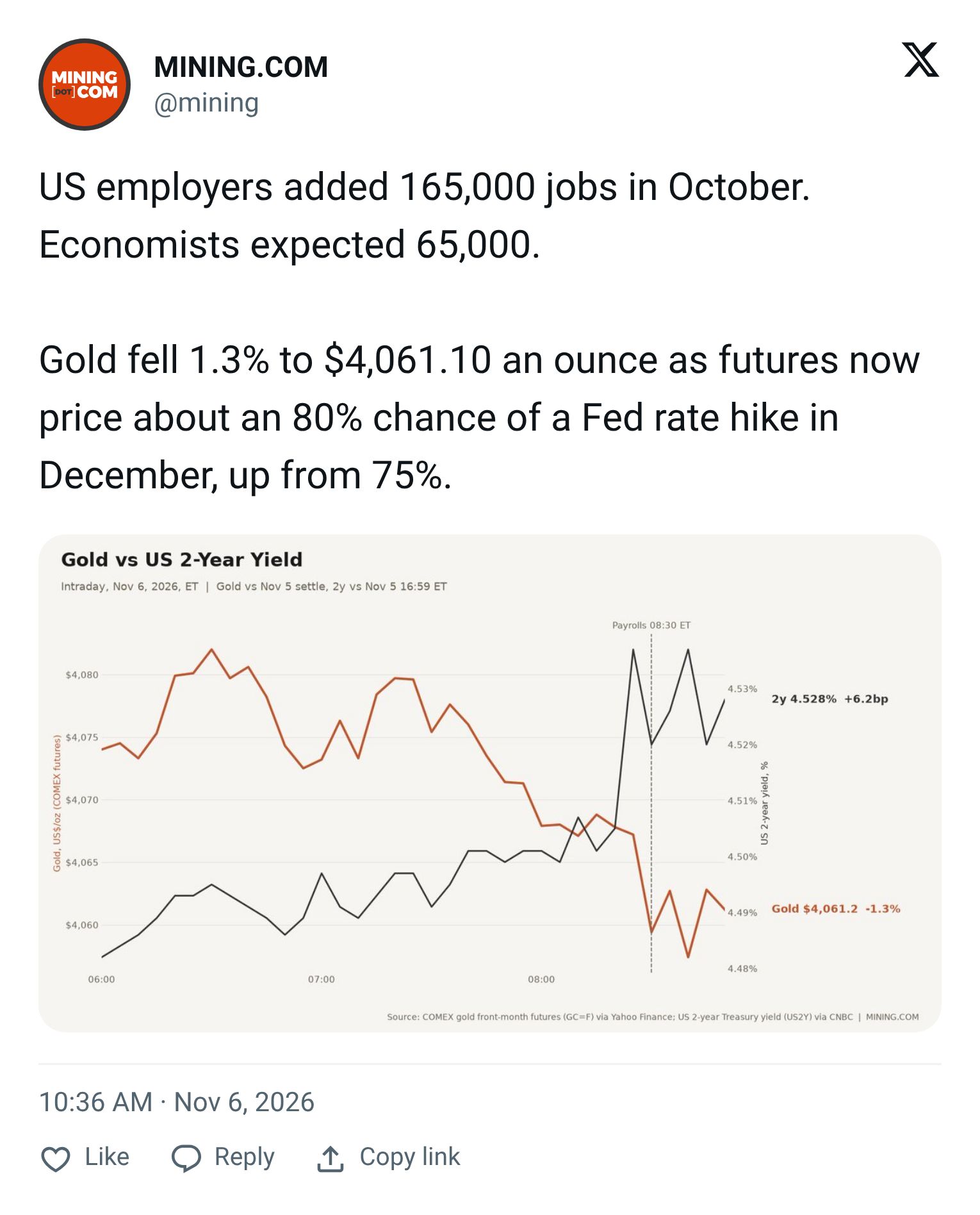
By Monday’s close they’d recovered and then some, with gold at $4,140 and silver at $53.41. The dollar softened, which makes gold cheaper for buyers using other currencies. Oil also fell about five percent on hopes for a diplomatic end to the Iran conflict, and cheaper oil eases inflation fears, taking a little pressure off the Fed.
The miners have caught up with gold
On Thursday I showed how the miners refused to follow gold to a new low at the end of October. Since then they’ve gone a step further.
Mining stocks usually fall harder than gold in a sell-off, because their costs are largely fixed and a lower gold price eats straight into profit. That was true for most of this year. By July, GDX, the most widely traded fund of gold-mining stocks, was nearly 40 percent below its February high while gold was down about a quarter.
That gap has now closed and flipped. Gold finished Monday about 24 percent below its January record. GDX is about 21 percent below its own high. For the first time since September, the miners are in better shape than the metal they dig up.

Each line shows how far gold and GDX are below their own 2026 closing highs.
Silver has the most ground to make up
Silver is still more than half below its January peak, while gold is down about a quarter. The gold/silver ratio, which measures how many ounces of silver it takes to buy one ounce of gold, was about 46 in late January. Today it’s about 78.

Daily closes. The gold price divided by the silver price.
That leaves silver with plenty of catching up to do if the recovery holds. It also tends to move faster than gold in both directions, because it’s an industrial metal as well as a monetary one, and the market has been running a supply deficit for several years. Neither of the two signs I’ve been watching has triggered yet. Silver needs to close above $55 and stay there, and the ratio needs to fall back toward 70.
Central banks didn’t wait for a bounce
By far the biggest support for gold this year has come from central banks. They bought 321 tonnes in the third quarter, according to the World Gold Council, 42 percent more than a year earlier and well above the five-year average of 227 tonnes.
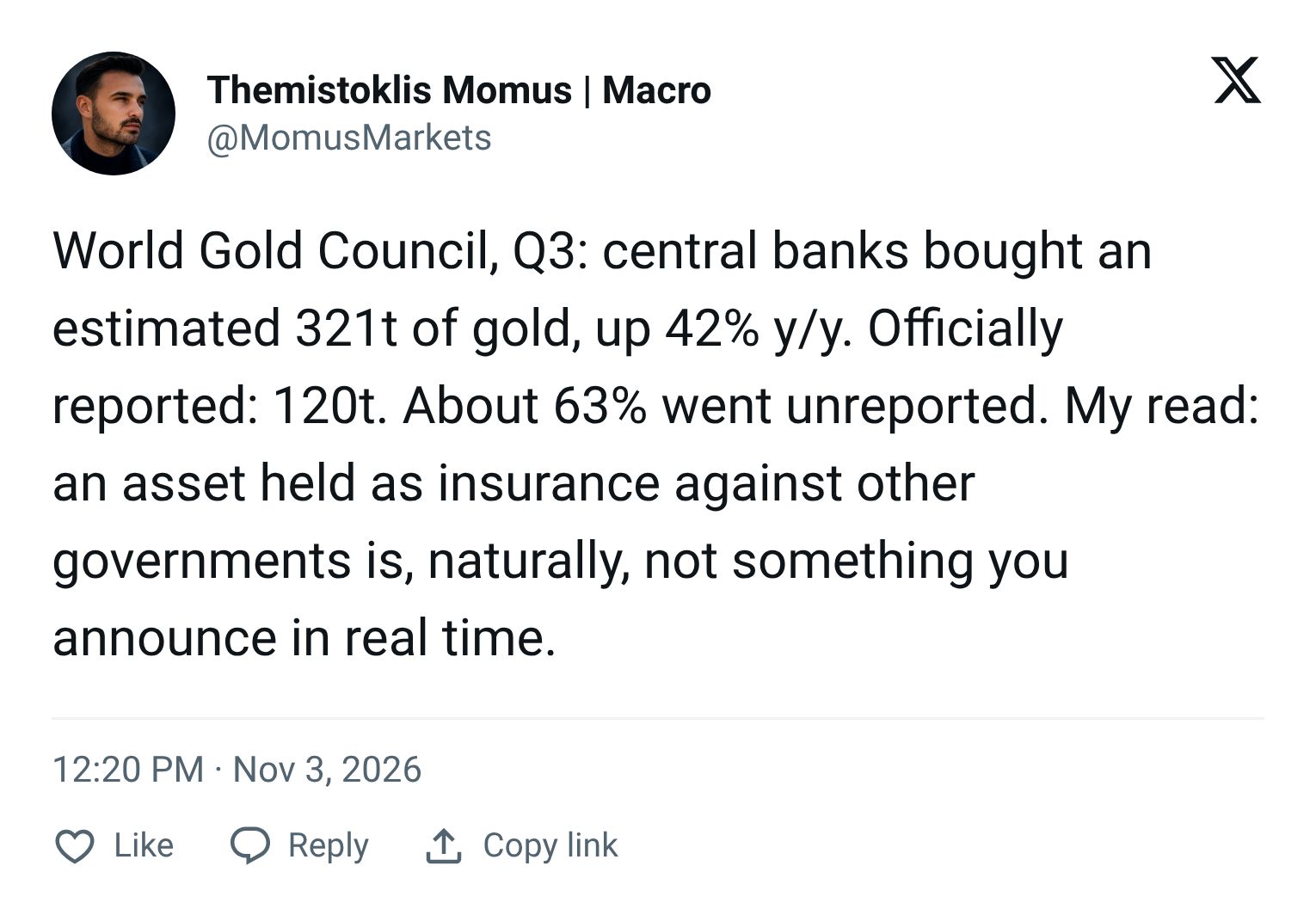
The gold price fell during the quarter, yet they bought more, not less. That fits long-term reserve building rather than chasing a rising price.
Bitcoin isn’t acting like digital gold
Bitcoin is often pitched as a digital version of gold, and this week argues against that idea. Faced with the same strong jobs report and rising rate expectations, Bitcoin fell while gold and silver moved higher. When investors get nervous about interest rates, they’re treating Bitcoin like a speculative tech stock rather than a store of value.
What to watch this morning
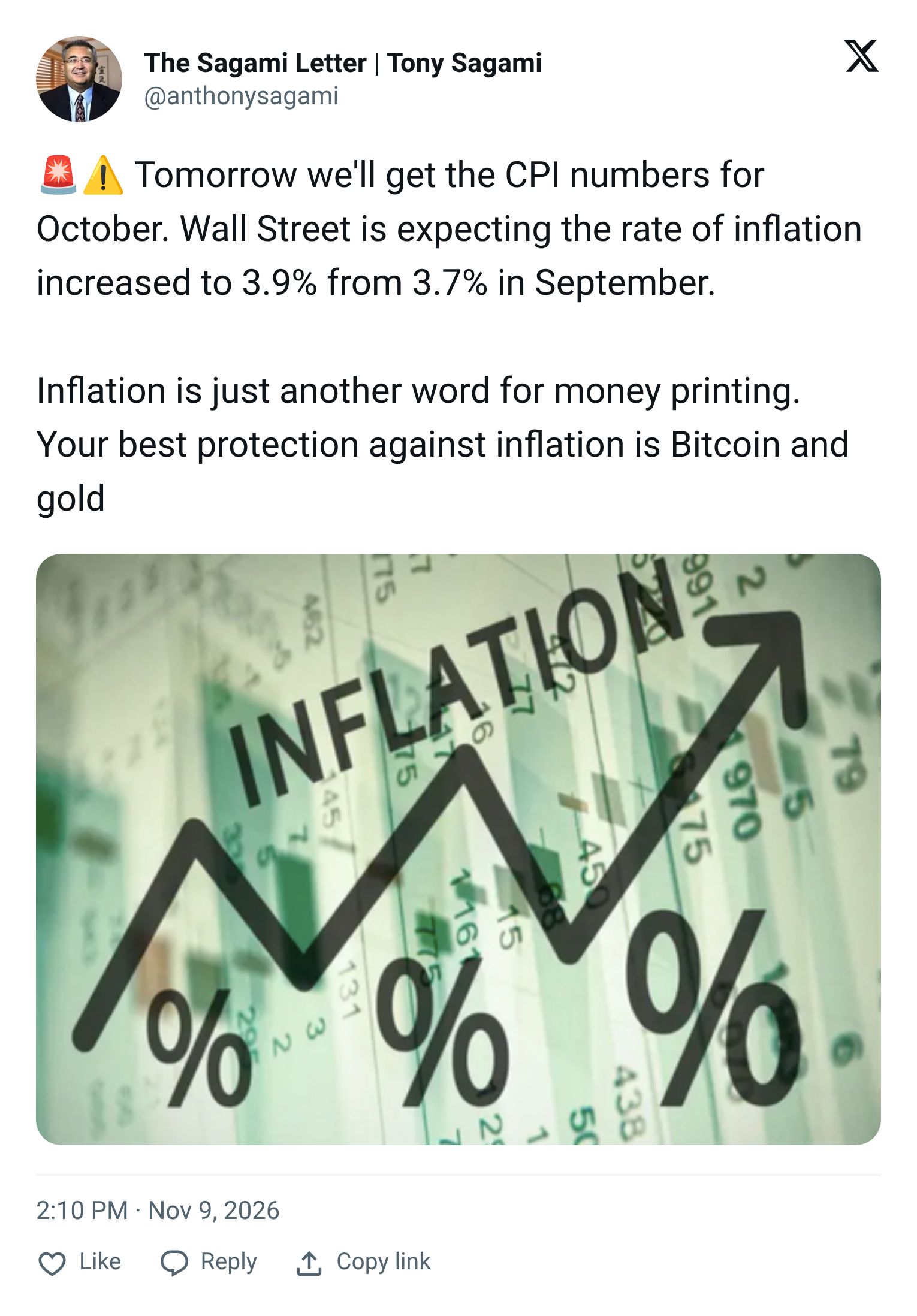
The first real test arrives at 8:30 Eastern, when the October inflation report comes out. Economists expect prices to have risen 3.9 percent over the past year, up from 3.7 percent in September. A hotter number would push rate-hike odds higher and could lift the dollar, which would weigh on gold and silver, and the miners would feel any drop more sharply.
Oil is the other thing to keep an eye on. Much of Monday’s relief came from hopes of Iran talks, and that can reverse on a single headline.
History offers some longer-range comfort. In the twelve months after each of the last 13 midterm elections, gold rose in nine, with a typical gain of about 13 percent.
The bigger picture
The past week tells a consistent story. Gold and silver have absorbed a strong jobs report and rising rate expectations without giving back their gains, and the miners, an afterthought for most of this year, are now holding up better than gold itself. Central banks kept buying through the dip, while Bitcoin’s stumble has made gold’s role as the original safe haven easier to see.
This morning’s inflation number may cause a wobble, but the evidence that money is starting to move back toward hard assets is stronger now than it’s been for months.
📦 Recommended Resources
Here are some of the companies I personally use and recommend:
Allocated Storage - BullionVault
🇺🇸 Gold IRA - My quick guide to Gold and Silver IRAs
🇨🇦 🇺🇸 Physical Delivery - Silver Gold Bull, Sprott Money
🔒 Where the Signals Stand
The miners are up about 18 percent in a week. If you own them, you’re probably wondering whether to add more or wait for a pullback. If you don’t, you’re wondering whether you’ve missed it.
INSIDER is built to answer exactly that. It runs separate signals for gold and silver miners alongside the metals themselves, using rules built on four years of research and more than 50 years of daily price data.
When a signal changes, members see it on their private page before the US market opens, so the decision comes from the rules rather than from a week’s headlines.
It’s what I use for my own investments.
14-day money-back guarantee. Cancel anytime.
That’s all for this Tuesday, folks. I’ll see you on Thursday.
Before you go, please take a moment to rate today’s newsletter and tell us how we did.
What did you think of today's GoldBuzz?
GoldBuzz INSIDER The System I Use for My Own Investing
GoldPrice.Live Live Prices, Charts and News 24/7
The Gold Awakening Download Your Free Copy Here
Enjoyed today's issue? Forward it to a friend who needs more gold in their life. They can subscribe at goldbuzz.com
Got feedback? Hit reply and let me know what you loved (or didn't).
Rick Adams
Founder, GoldBuzz
rick@goldbuzz.com
