
Happy Sunday, GoldBuzzers!
Gold and silver had another rough week, and a lot of people are asking the same question - if central banks are still buying, who’s doing all this selling? The answer’s in the data, and it’s a lot more reassuring than any price chart.
Ok. Let’s get into it. ⬇️
The Scoreboard 🏆

Gold ended Friday flat at $3,874, but that quiet close hid the metal’s worst week since early June, with futures down almost five percent and Thursday’s dip to $3,857 marking a 13-month low. Silver dropped around 2.6 percent on Friday to $48.80, back below the $50 line. The pressure came from a familiar pair - a US dollar at a 19-month high and ten-year Treasury yields above 5.1 percent, both powered by hardening expectations that the Federal Reserve raises rates again next month.
Tuesday’s report showing consumer prices up 0.4 percent in October did most of the damage, and even though Friday’s producer price reading came in softer than forecast, markets still put the odds of a quarter-point December hike near 90 percent. Rising oil prices on fading hopes for peace in the Middle East aren’t helping the inflation picture either.
Silver carries an extra weight of its own, with the Silver Institute’s researchers expecting demand to fall five percent this year to 1.08 billion ounces. Until the Fed’s December meeting settles the rate question, the dollar will keep calling the tune for both metals.
Deep Dive 🔍

Who’s Selling Gold?
On Thursday, gold touched $3,852, its lowest price in 13 months. It ended the week down about five percent and is now roughly 28 percent below January’s record close of $5,420. Silver had a rougher time still, settling Friday at $48.65, a one-year low.
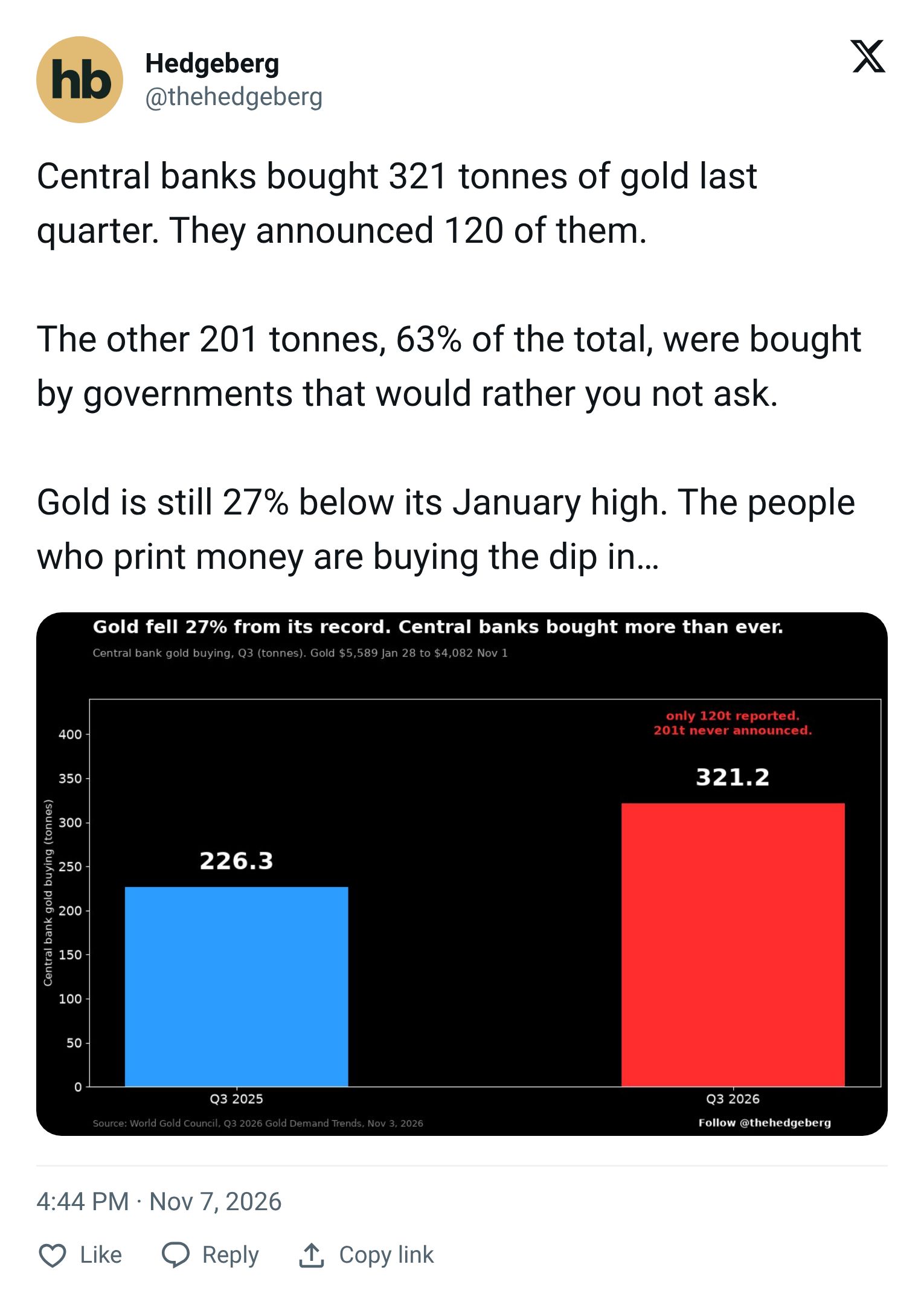
That’s a strange result for a metal that’s supposed to be in such demand. Central banks added 321 tonnes of gold between July and September, 42 percent more than a year earlier. Gold ETFs around the world ended October holding a record 4,275 tonnes.
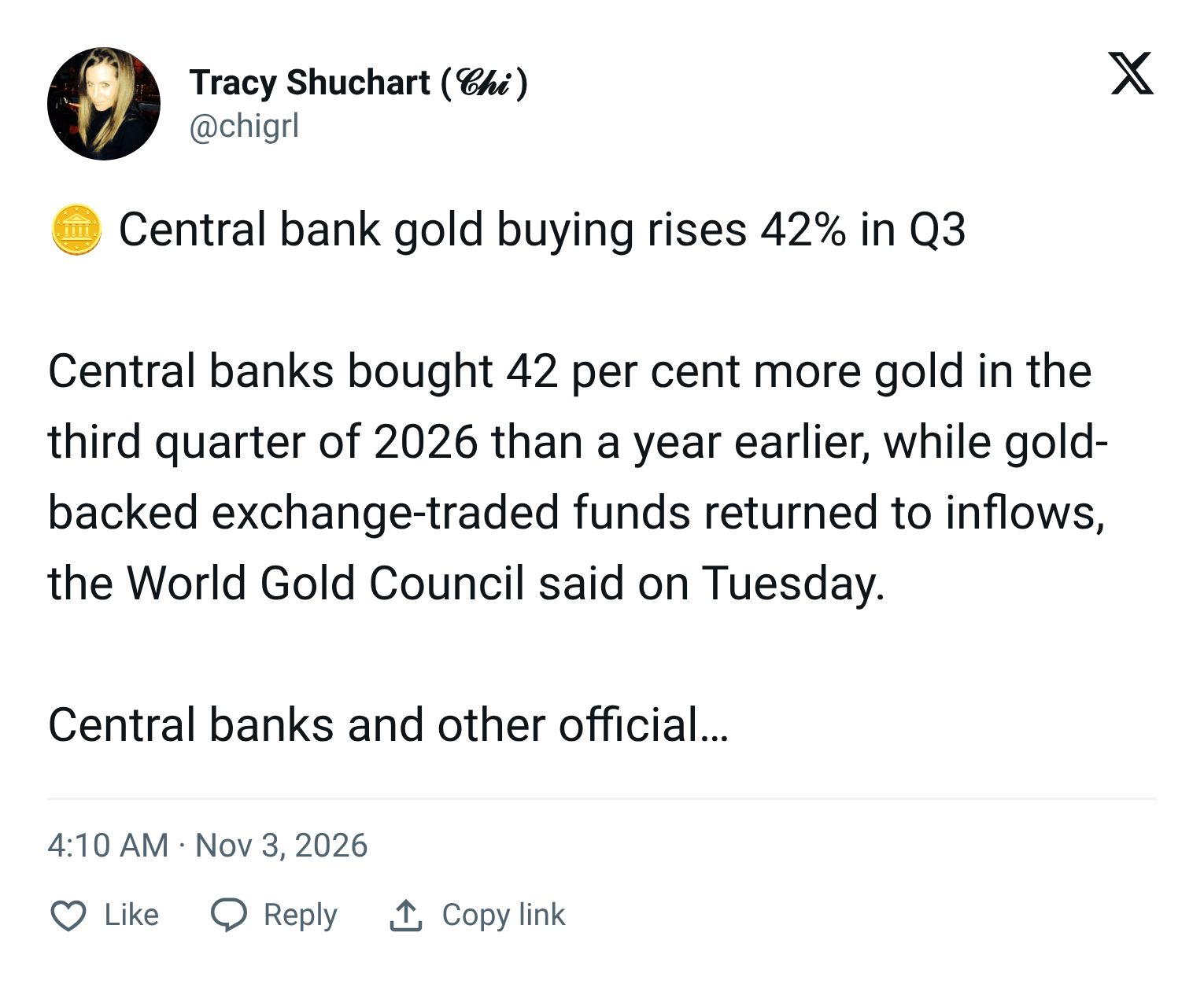
With that much buying going on, somebody has to be doing the selling. It’s no great mystery who. Gold has two very different kinds of owner, and only one of them is heading for the door.
Two kinds of gold owner
The first group buys gold to keep it. Central banks are in this camp, and so are Indian families buying for weddings and festivals. They don’t watch the price every morning, and a bad week doesn’t change their plans.
The second group is there for the price move. That’s hedge funds trading gold futures, along with investors who hold gold through funds they can sell with a click. When something more attractive comes along, they leave.
Day to day, the price is set by whoever’s most eager to trade, not by whoever owns the most. Long-term owners hardly trade at all. So when short-term money rushes out, it decides where the price goes, even though it’s the smaller group.
Why the short-term money is leaving
Mostly, it comes down to interest rates.
A 10-year US government bond that’s protected against inflation now pays nearly 2.9 percent a year on top of inflation, for anyone who holds it to the end. A year ago, that figure was under two percent, and it’s now at its highest level since 2008. Gold pays no income at all, so when a near risk-free bond pays that well, plenty of traders would rather own the bond.

Gold: daily closing prices. Real yield: 10-year Treasury Inflation-Protected Securities yield, Federal Reserve via FRED (series DFII10). Latest yield reading November 12.
The strong dollar is making things harder too. It hit a 19-month high this week, and traders are betting the Federal Reserve will raise rates again at its meeting ending December 9. On Friday, producer prices were shown to be up 6.5 percent over the past year, the fastest rise since November 2022. That gives the Fed little reason to hold back.
You can see the exit in the numbers. In the futures market, large speculators cut their net bet on a rising gold price by about a fifth between late August and early November, and that was before this week’s drop. In October, money flowed out of North American gold funds, while funds in Europe and Asia kept adding.
Who’s still buying
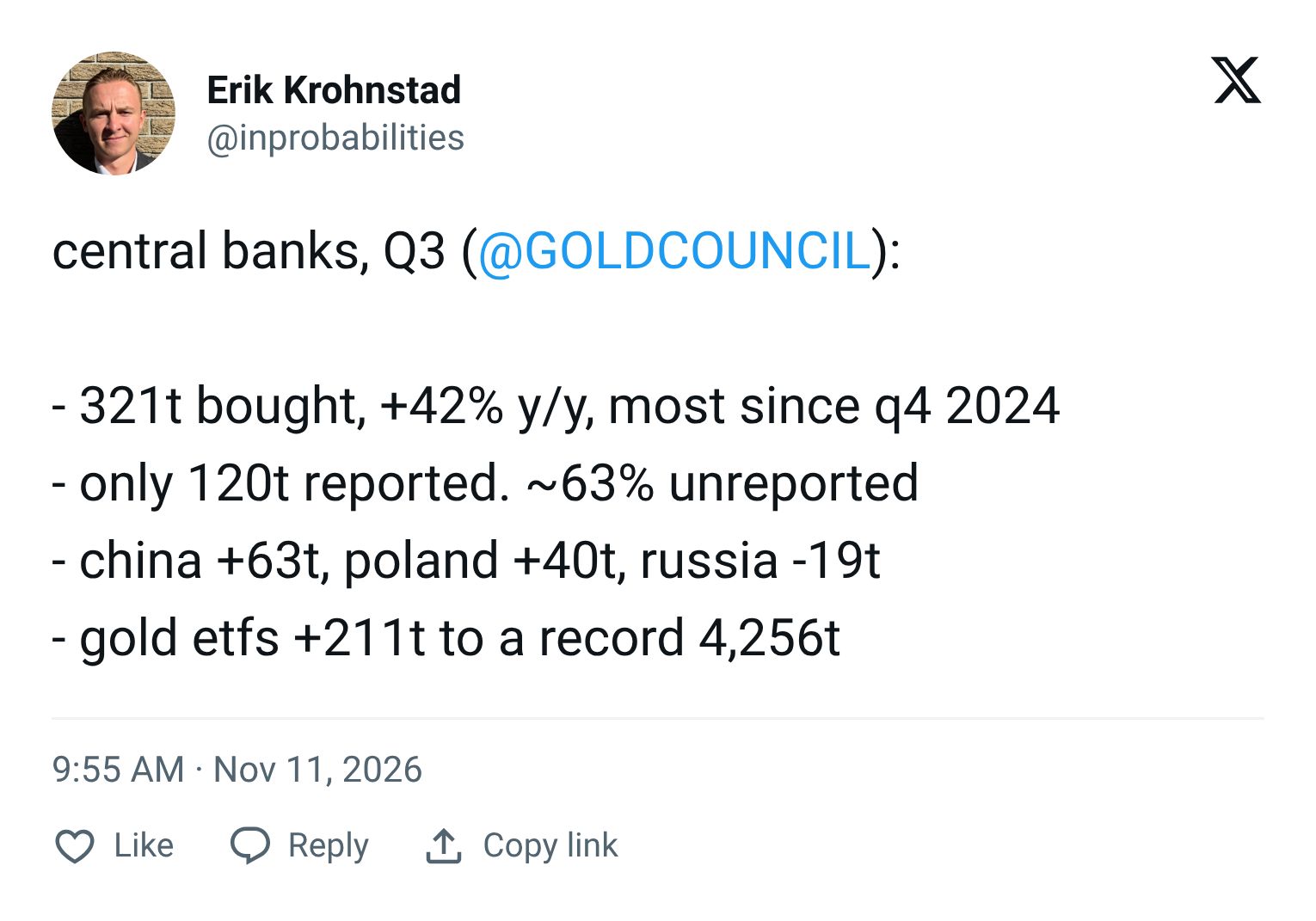
Central banks, for a start. The World Gold Council says their third-quarter buying was the biggest of any quarter since late 2024. China’s central bank reported buying 63 tonnes and Poland’s reported 40. The council has since raised its forecast for central bank buying this year.
In India, gold sales over Dhanteras, the first day of Diwali, came in about 15 to 20 percent higher than last year by value, according to early estimates from the country’s jewelry trade council. By weight, sales were roughly flat, which points to steady demand rather than a frenzy. Silver did better, with sales up about 30 percent by value and 10 percent by weight.
Closer to home, Andrew Sleigh, senior broker at Sprott Money, told me last month that his wealthier clients were buying in steady monthly amounts. One had moved $3 million into metal over four months to get out of paper money.
What it adds up to
There’s no contradiction here. The sellers are reacting to this month’s interest rates while the buyers are planning years ahead, and for now the sellers are setting the price.
That won’t last forever. When rates turn, the traders who left will want back in, and they’ll be competing for metal with buyers who never stopped. Central banks have bought six percent more gold so far this year than in the same months of 2025, even as the price fell.
This is the consolidation phase of a bull market that began in 2024. This week’s selling came from short-term money reacting to the Fed, and the data confirms long-term buyers who drive gold over years haven’t gone anywhere.
📦 Recommended Resources
Here are some of the companies I personally use and recommend:
Allocated Storage - BullionVault
🇺🇸 Gold IRA - My quick guide to Gold and Silver IRAs
🇨🇦 🇺🇸 Physical Delivery - Silver Gold Bull, Sprott Money
🔒 Where the Signals Stand
If you’ve felt this year’s fall in your own portfolio, you’re not alone. Fortunately, GoldBuzz INSIDER’s signals have kept our members on the sidelines for most of it.
The gold system stepped out of the market on June 1st and has since avoided a 13.4 percent fall. The silver system followed on September 23rd at $64.44, ahead of a 24.3 percent drop.
Knowing when not to trade matters more than knowing when to trade as you can buy a lot more metal when the signals turn Bullish. Our members see every change on the members’ page the morning it happens.
14-day money-back guarantee. Cancel anytime.
That’s all for this Sunday, folks. I’ll see you on Tuesday.
Before you go, please take a moment to rate today’s newsletter and tell us how we did.
What did you think of today's GoldBuzz?
GoldBuzz INSIDER The System I Use for My Own Investing
GoldPrice.Live Live Prices, Charts and News 24/7
The Gold Awakening Download Your Free Copy Here
Enjoyed today's issue? Forward it to a friend who needs more gold in their life. They can subscribe at goldbuzz.com
Got feedback? Hit reply and let me know what you loved (or didn't).
Rick Adams
Founder, GoldBuzz
rick@goldbuzz.com
